

Make / Model Search
OptionsCar reviews - Kia - K4 - GT-LineKia modelsOverviewWe like Rewarding driving dynamics, good balance of occupant comfort and road holding, strong feature list, attractive cabin design, flexible interior, quality feel Room for improvement Engine raspy under load, contentious styling, expensive service costs, low ride height Kia’s K4 Hatch is a big step up from the outgoing Cerato4 May 2026 Overview
NO-ONE vocally rues the day the SUV arrived. Now, what preceded it is almost completely lost to time.
That is until you have a chance of driving what our parents treated as typical automotive fodder - the sedan, the wagon or the hatchback.
Even models that were previously known as hatchbacks have been now sold as SUVs for example Suzuki’s Ignis, Mazda’s CX-30, the Smart #1 and #3, Suzuki S-Cross, Toyota C-HR and more.
There’s a lot of difference between a sedan, or hatchback, and an SUV and most of it is in the driving experience.
In the hatchback’s case, cabin room and luggage space is on par with or occasionally better than the equivalent-size SUV.
The feature list is also pretty much identical so you’re not missing out on much.
But the stand-out difference can be the price. Hatchbacks and sedans tend to be quite a bit cheaper than the equivalent SUV – it’s the main reason why sales are now creeping into SUV territory in markets including the US, where the Camry in January outsold the RAV4.
Kia’s new K4 hatch costs from $32,090 +ORC for the 2.0S automatic (Kia doesn’t make the K4 with a manual gearbox) and $43,790 +ORC for the GT-Line variant tested here.
That’s about $10,000 less than the Sportage GT-Line – which has similar equipment plus all-wheel drive – and similar to the outgoing Seltos SUV. The 2027 Seltos, due in Q4 this year on a smaller wheelbase than the K4, is expected to be about $45,000-$46,000 in top-line specification.
The K4 GT-Line also gets features including the Harman-Kardon audio and panoramic roof with opening sunroof.
The boot holds 438 litres (rear seat up) and has a space-saver spare under the boot floor.
The K4 hatch is a five-star crash rated car (ANCAP) with high scores across the board, including 83 per cent for adult occupant safety assist features.
Safety kit is pretty comprehensive and includes AEB, adaptive cruise control, blind-spot assist, lane-keep and lane-following assist, blind-spot detection and collision avoidance, rear cross-traffic with collision avoidance, seven airbags and intersection monitoring and avoidance.
It also has a speed warning (a noisy four beeps when you’re 1km/h over the posted limit) system that thankfully can be turned off. Unfortunately, it has to be turned off every time the car is restarted. Better than the constant beeping, though.
Kia has a seven-year or unlimited distance warranty and up to eight years of roadside assistance, requiring the owner to keep the car serviced at a Kia dealership.
The capped-price service program costs $3877 for a total seven year, averaging $553 a year but weighted to up to around $700 each for the last two years. That’s not especially cheap for a small four-cylinder car.
Driving Impressions
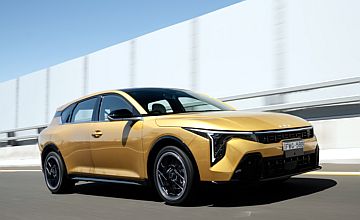
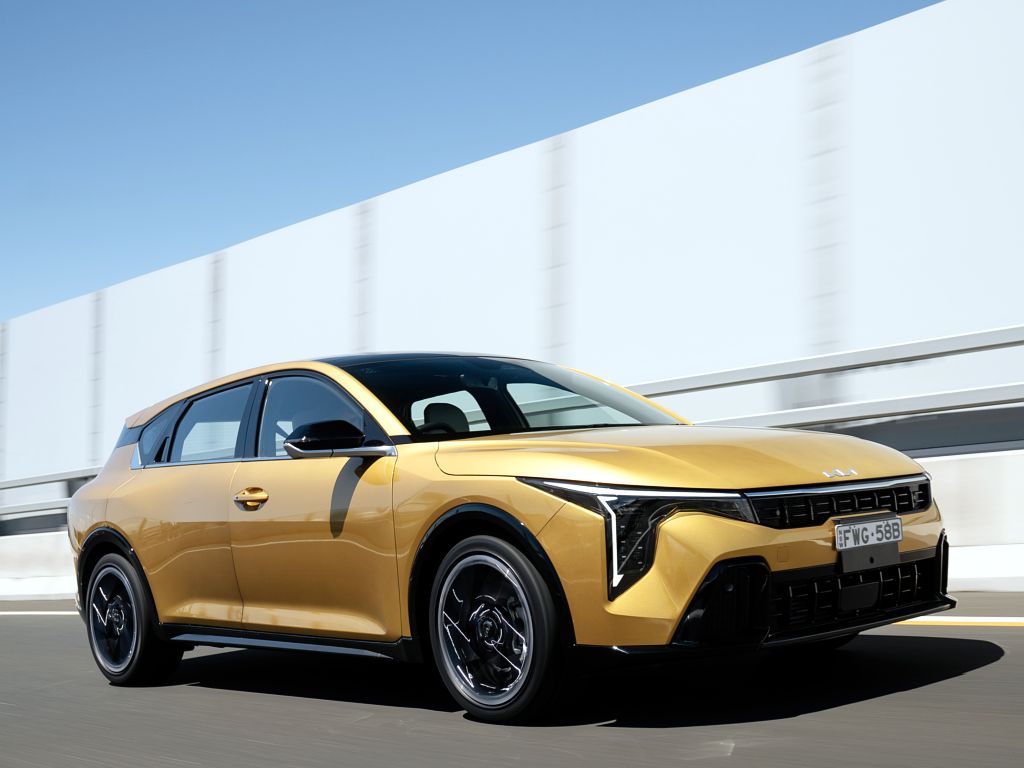
It’s low, especially if you’ve just transitioned from an SUV. The low stance, compact feeling of the cabin and the way the dashboard surrounds the driver makes it feel sporty before you even press the start button and hear the engine.
And yet the interior is welcoming, really well trimmed with designer-influenced colours and materials that give the K4 a sense that it’s been bolted together by someone who cares.
From the driveway to the highway, the K4 is forgiving and benign, quick to react to accelerator pedal input and with brisk performance. Treat it gently – as I’m sure most owners will – and it’s quiet and smooth. Push it a bit harder and the engine sparks up quickly although it comes with a raspy backdrop.
The engine is Hyundai-Kia’s longstanding 1.6-litre turbo petrol that in previous models, mostly ran through a dual-clutch transmission. It’s now a less fussy conventional torque converter auto with eight gears.
Although the change to a normal automatic has blurred some of the sharpness of the DCT’s gear changes - particularly when climbing through the cogs- it’s still quick enough to retain some sporty feel.
Better is the lack of any jerkiness between changes, with the resulting smoothness giving the K4 more civilised road manners. There is, of course, the potential that the new box will also be more durable than the old one.
The DCT still exists in the brand’s inventory, being used in the N models because of its superior driving performance, including quicker acceleration.
The engine is rated at 142kW at 6000rpm with 265Nm of torque at 1700-4500rpm – the latter being the heart of the car’s easy driving nature and what gives it nice punch out of a corner.
Power is down on the same (basic) engine in the Hyundai i30 N-Line sedan (150kW/265Nm) and the 2.0-litre i30N (206kW/352Nm) and yet up a bit from Kia’s Sportage (132kW/265Nm).
Kia claims 7.4 litres per 100km and, unusually, says the K4 sedan with the same engine is more economical at 6.7 L/100km. Importantly, it runs on the cheapest petrol available (91RON) and draws from a 47 litre tank, which could take you about 635km when topped up.
An interesting point is that Hyundai no longer makes a hatch version of the i30 (except the top-spec i30N) for Australia, giving the Kia a bit of a marketing leg up. The K4 now competes mainly with hatchback models from Corolla and Mazda3.
The K4 sits on a 2720mm wheelbase using a Hyundai-Kia K3 platform also used for the Hyundai i30 sedan and Kona, and Kia’s Niro and Seltos.
Australia gets a bespoke suspension tune that makes it better suited both to our roads and to our inherently more sporty driving nature.
But this tuning doesn’t create a firm “sports” ride, rather the handling is confident and predictable, while remaining cushioned enough so occupants don’t feel like they’re being rattled in a box.
Drivers will note that the seating is low but visibility is good, with the broad two-panel 12.3-inch dash screens (one for the driver with instrumentation, the other for passengers with infotainment functions) being perfectly placed and with good room for personal storage in the centre console.
Kia retains some manual switchgear for frequently-used functions (HVAC, for example) and pushes some additional switches away from the centre – notably the seat and steering wheel heater/venting controls (GT-Line only) which now live on the door panels – to separate controls based on location and priority.
There are a lot of attributes in the K4 hatch. But there’s a lot of competition and the decision on whether it suits you may come down more to your taste in car styling, rather than the practicalities of ownership.
 Read more20th of January 2026  2026 Kia K4 Sedan GT-Line ReviewIs the K4 a worthy Cerato replacement? Or does an uptight ADAS suite spoil the show?11th of December 2025  2026 Kia K4 Hatch reviewKia K4 Hatchback joins same-under-the-skin, same priced K4 Sedan |
OptionsClick to share
|


 Alfa Romeo
 Abarth
 Audi
Audi Aston Martin
 BMW
BMW Bentley
 Ferrari
 Chevrolet
 Ford
Ford Fiat
Fiat GWM
GWM Foton
Foton Hyundai
 Honda
Honda Jaguar
 Isuzu
Isuzu Kia
Kia Jeep
Jeep Land Rover
 Lamborghini
 Maserati
 Lexus
Lexus McLaren
 Mazda
Mazda MG
MG Mercedes-Benz
 Mitsubishi
 Mini
Mini Peugeot
 Nissan
 Ram
Ram Porsche
 Rolls-Royce
 Smart
Smart Skoda
Skoda Suzuki
 Subaru
 Toyota
 Tesla
Tesla Volvo
Volvo Volkswagen
 Zeekr
Zeekr

Connect with us


Facebook Twitter Instagram